The boys were watching television; that was good.
Her husband wasn’t home yet. He never managed to catch the same train because he said it was impossible to judge how much work he had left. Said. Not that she didn’t believe him, and understood it was the fault of the partners, who never seemed to realize that something was due until 5 o’clock the night before. And everyday was the night before.
But tonight he phoned to say he was getting the 6.45. He’d spoken with their older son, who finally was capable of answering the phone responsibly. He had a clear speaking voice. “Rieser Residence,” he’d say, and for a split second, through his carefully enunciated words, she could project her son’s future man’s life ahead of him. Then he’d look over at her and mouth someone’s name melodramatically, as he’d surely seen her do, inevitably announcing the caller without his hand over the receiver, so she was obliged to talk even when she didn’t care to.
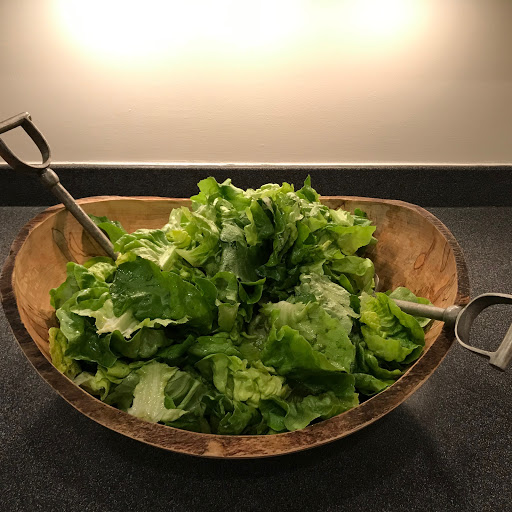
Tonight, though, he\’d just said, “Hi, Dad,” and she\’d turned back to the lettuce she was washing. The smell of fish nuggets filled the room – she’d assuaged her guilt at the frozen dinners her new work schedule had reduced her to cooking by buying wild caught and sustainably raised (how could both be true?) cod breaded into tiny child friendly fish-shaped portions. Cooked. Heated was more like it. The most labor intensive part of this dinner was the peeling of the carrots and the slicing of the peppers. She didn’t even make her own dressing anymore!
Which wouldn’t be so bad if she didn’t understand – really comprehend on a local and global organic level – that nutrition was so important and when parents worked, it was one of the first things to be laid aside, abandoned. Just like the life she was portraying right now. The depths to which she’d fallen.
When she was ten she’d begun cooking for herself, a journey which had lasted all the way to the birth of her second son, when the time shrunk into barely manageable days and the weeks clumped together and drew in the family details like the butter she used to mix into bowls of white sugar before each individual sticky granule folded itself into a uniform, predictable dough. Or life.
One of the kids was calling – the show was over. They rushed in a competitive dash from the living room to the kitchen, her younger trailing a long string of construction vehicles, each carrying a stuffed animal, behind him. “Is dinner ready?” he bellowed, in his construction worker voice.
“Is Daddy home yet?” inquired the older, angelically.
“Five minutes, and no, not yet,” she said, suspicious of his tone.
“I need you to tell me something to do!” said the train dragger, who was just three, while the five year old wandered to the living room windows to watch for his father.
There really wasn’t anything wrong, in particular. Work was fine, money was good, the part-time nanny was working out. She was even getting along again with her husband, now that a balance was returning to their routines, their places in the outside world, in their childrens’ lives, their home, their marriage.
The doorbell rang. It occurred to her that she didn’t have a drink to put down yet. What had she been doing since she got home? Her son was opening the door before she got there: it was Laini from across the street, carrying her new baby, and holding a large tupperware container.
“Hi, I’m sorry to barge in. We got another meal train delivery today – and they’re great, I’m so grateful – but there’s just too much food. I’m still on the lasagna from two days ago and Dave doesn’t eat anything, and anyway, this salad is dressed already, so I can’t save it, but it has walnuts and blue cheese and pears. It’s exquisite. I thought you should have it.”
Her boys were clamoring around her. “Can we hold the baby? Can I touch it? Do its eyes work yet? Can it see us yet?” And then Russ came trudging up the front stairs, winded, puffs of steam drifting from his mouth, and the kids’ cries turned to “Daddy,” their little bodies unable to contain the excitement piling up in their front doorway.
“Well, I’d better go,” said Laini, stepping away from Russ. “Will we see you on Saturday?”
She said she’d be there, and closed the door behind her husband, who was lifting both of the boys into the air. “I have a lot of work tonight,” he said, “but I want to eat with everyone first.”
She followed him into the kitchen. She had a lot of work, too.
“We have salad,” she said. “It has pears.”
 everywhere tints childrening
Leave a comment